
Pharmaceutical Price Control in Europe:
A Case for Reform (April 2004)
Sean Gabb
Note: This is a piece of hack writing for a drug company. I was paid well for it. Because it at least hints at the need for a big state to keep up the profits of the drug companies via intellectual property law enforcement, it should not be taken as representing any opinion I hold or have ever held. SIG
Introduction
In his essay “What is Seen and What is not Seen”, published in June 1850[1], the great French economist Frédéric Bastiat noted that human actions are attended by two kinds of consequence. The first are the intended consequences. These are highly visible, and usually beneficial. The second are the unintended consequences. These are generally invisible, and often deeply harmful. Such is the case today with pharmaceutical price control in Europe. Its seen consequence is to hold down medical costs, allowing wider access at any one time to treatment than would otherwise be the case. Its unseen consequences are to diminish the range of treatments available in the long term, and to increase medical costs; and to kill or otherwise to harm as many as 42 patients every hour throughout the western 15 member states of the European Union.
Reasons for Price Control
Every member state of the European Union has some kind of welfare safety net for its citizens. In all member states, perhaps the most important part of this safety net is the health care system, in which medical treatment is made available to citizens without regard to ability to pay. The financing of health care differs across the member states. In Britain, the National Health Service aims to provide a universal system of care free at the point of use. In most other member states, it is provided more or less by the independent sector, with means tested subsidies or reimbursements given to individual patients by the State.
However financed, the burden of public health care has pressed increasingly heavy on European tax payers for at least the past generation. Because people are living longer, they are dying of illnesses for which there is no cure, and for which palliative treatments are complex and expensive. Even otherwise, people are now expecting more of health services than ever before. Unlike their ancestors, people now are less willing to live with chronic pain and disability.
Because it is the largest and most elaborate scheme of provision in Europe, these effects can be seen most clearly in the budgets of the National Health Service. Government spending on the system has increased by 50 per cent in money terms since 1997. The 2002 budget outlined plan to increase spending by a further £18 billion over the next three years.[2] Even so, complaints continue of underfunding. Almost as clearly, these effects can be seen in every European health service. In France, for example, the health service may be as much as €14 billion per year in deficit by the end of 2004.[3] As of April 2004, the Slovak health service was running a deficit of 9 billion Crowns – or €200 million.[4]
There are numerous ways of dealing with this inflation of health care costs. One of the easiest and most obvious, though, is to cut the cost of the drugs bill. This is not the most important single cost, but it is a large cost. Pharmaceutical products, for example, account for 12 per cent of the National Health Service budget, and is somewhat higher in most of continental Europe.[5] Any reduction is likely to be welcomed by the politicians and managers who are trying hard to squeeze as much as they can out of increasingly inelastic budgets.
Schemes of Price Control
For this reason, every member state of the European Union has in place some scheme to regulate the price of pharmaceutical products. In every member state, the state is the largest singly buyer – directly or indirectly – of pharmaceutical products; and so the health authorities can use their monopsonistic power to negotiate lower prices than would otherwise obtain. These prices are then enforced generally through laws that prohibit the charging of different prices for the same product. To give a detailed review of these schemes across 15 countries is not possible in so short a publication as this. Indeed, as the schemes generally lack transparency, even an overview would require a book in itself.[6] In brief, however, the regulatory schemes can be set within two categories.
First, there are those countries where prices are set largely by reference to marginal cost of production. These countries are: Austria, Belgium, Denmark, Finland, France, Luxemburg, Spain, Sweden, and – in part – Germany. Here, prices are supposed to reflect production costs and allow for a certain margin of profit. However, negotiations between pharmaceutical companies and the health authorities often lead to prices based on criteria hard for outsiders to comprehend.[7]
Second, there are those countries where prices are set largely by reference to the price of the same product in neighbouring countries. These countries are: Greece, Holland, Ireland, Portugal, and – in part – Italy. In most cases, average prices are based on controlled prices, and so there may be a further downward pressure.
The exception to this rule is Britain, where the National Health Service uses its immense buying power to get lower prices, but allows an average profit of 21 per cent to its pharmaceutical suppliers, and is willing to allow the margins of specific products to vary significantly.
Price Control: A Microeconomic Analysis
Now, in most of its forms, price control leads to consequences that are immediately bad and that can be reasonably comprehended. If, for example, a government wants to fix the price of some product below its immediate costs of production, there will be an increase in demand and a fall in supply, leading to shortages in the market. We can see this in figures 1 and 2.

In figure 1, the market is in equilibrium. When the price is €5 per unit, 500 per day are demanded and 500 are supplied. Consumers can buy as much as they wish to have at the price charged, and suppliers will sell as much as they care to bring to market.

In figure 2, a maximum price of €3 has been set. At this price, producers will find it profitable to supply only 300 units per day, while consumers will want to buy 700 units per day. There will be an excess demand of 400 units per day. The effects of this will be seen in queues and empty shelves and in some degree of trade on the uncontrolled grey market, where a new equilibrium price – probably somewhat higher than before, bearing in mind the increased transaction costs and the risk of legal action – will emerge to close the gap between supply and demand.
Pharmaceutical Price Control: An Exception?
The effects of price control are different where pharmaceutical products are concerned. In no European country are prices set below marginal cost of production – and it would be hard for this to happen, bearing in mind in most cases the very low marginal costs of production. Instead, profit margins are squeezed. There are no obviously harmful effects here, as pharmaceutical products are still supplied so that, even at the new lower price, there is no shortage. Indeed, it can be argued that price control here has wholly beneficial effects.
Because their products have several years of patent protection, during which time they cannot be legally copied, pharmaceutical companies are in the same position as short run profit maximising monopolists. They control supply of their product, and can drive up prices by restricting output. According to the standard neoclassical analysis, a monopoly will maximise profit by limiting output to the point where marginal cost is equal to margin revenue. We can see this in Figure 3.

Here, a monopolist has restricted output to point Q, and is able to charge price P. His profit therefore is equal to price less average cost, multiplied by output – or (P-AC)xQ. At this level of output, the monopolist is productively inefficient, as average cost is higher than the theoretical minimum – where MC=AC. He is also allocatively inefficient, as price is far higher than lowest average cost. We have here what is called “market failure”.
If a government now sets a price equal to the lowest average cost, the monopolist will have no incentive to restrict output, but will increase output to the productively and allocatively efficient level where marginal cost is equal to average cost. As such, price control can in theory force a monopolist to behave like a firm in a perfectly competitive market. We can see this in Figure 4:
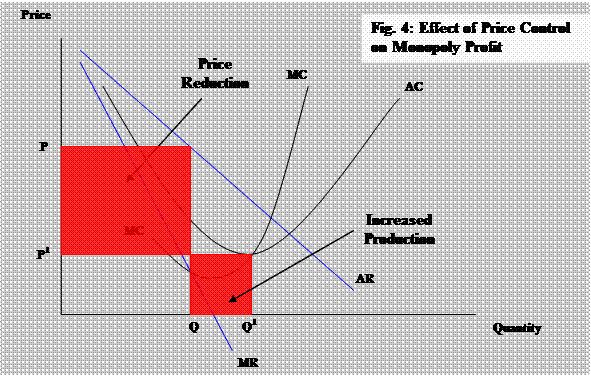
Here, the price has been forced down from P to P1, which is equal to lowest average cost. In this case, a monopolist can now maximise profit only by increasing output to the productively and allocatively efficient level – where MC=AC. Not only here has price control not created a shortage, but it has even brought about an increase of supply at the lower price.
The Unreality of Neoclassical Analysis
All this follows, but only in the light of certain highly unrealistic assumptions. It is assumed that manufacturers are able to know the present shape of their revenue curves. They do not. Demand functions are in fact radically indefinite, and indeed unknowable in advance. Even when it seems possible to draw revenue curves, these are conjectural and based on information that may be wholly out of date. Suppose, for example, that a decrease in price for some commodity is accompanied by an increase in quantity bought. Does this show a movement along an unchanged demand curve? Or does it show an independent shift to the right of the demand curve? In the real world, we can never know the answer to this rather basic question. And so, in the real world, any attempt at measuring demand elasticities must always be a matter of guesswork rather than the precise analyses given in the standard texts. This being so, it is simply not possible for an outside authority to set prices that will reproduce the productive and allocative efficiencies of perfect competition.
In fact, price control may have affected the availability of pharmaceutical products in the short term. In 2002, Pfizer told the French Government – in France, prices are about 40 per cent of the American level – that it might withdraw certain products from the French market. AstraZeneca also said it was thinking of withdrawal from various European markets.[8] There is evidence, then, that regulation is not necessarily moving prices and output to the productively and allocatively efficient levels.
Indeed, even if it were possible to set prices that brought a market close to the perfectly competitive equilibrium, it would not be desirable. The formal analysis in the textbooks is given on the assumption that no further improvement can be imagined. And any attempt to make markets behave according to this model will prevent improvement.
Profits and Innovation
Taking into account research and development and regulatory compliance, it costs about $800 million to bring a new pharmaceutical product to market.[9] Many of these costs are incurred whether or not the product is actually put onto the market. For every one new product put on the market, 5,000 chemical formulations do not make it: either they do not work as expected or they are outperformed or simply beaten to market by a rival product. Once on the market, they have only a few years of profitability – before the patent protection expires, or before an improved product is released by another company. A recent study of 100 pharmaceutical products showed that the profits earned on most of them did not cover investment costs.[10]
Therefore, the pharmaceutical companies adopt a strategy of contributive skim pricing. The price of a new product is set far above immediate costs of production, and even above its own development cost. Some part of the resulting surplus may represent profit in the economic sense. In many cases, though, it will be taken as a contribution to the general development costs of the company. In other words, those products that do succeed are priced to cover the costs of developing all products, whether or not successful.
A further refinement of this pricing strategy would result in different prices even without regulation. There are many countries where people are too poor to pay the full cost price of pharmaceutical products, but not too poor to buy at any price. In these countries, the pharmaceutical companies set prices to cover marginal cost of production plus whatever contribution to overheads can be charged. The motivations behind this policy are neither charity to poor countries nor desire to exploit patients in rich countries. It is simple profit maximisation. Companies distinguish between overheads and marginal costs. Price must always cover the latter, but may include a variable contribution to the former. Prices in poor countries are set to make a small contribution to research and development overheads, and a larger contribution is taken in rich countries. It makes economic sense, though the result is prices are largely determined by ability to pay, and patients in poor countries receive a large indirect subsidy from patients in rich countries.
How Price Control Increases Medical Costs
While it may enable the pharmaceutical companies to make an operating profit on the products being sold, price control will in the long term reduce the number of new products introduced to the market. And this may actually increase pressure on health budgets. There are, of course, no direct means of calculating the cost of progress that does not take place. Even so, there are indirect means. We cannot measure the value of progress that will not take place. But we can measure the value of progress that has been made. An American study shows, for example, that every dollar spent on drugs is associated with a $4 decline in spending on hospitals.[11] There are other examples:
A Swedish study of the direct costs for treatment of cancer patients from 1985 to 1996 found that as the costs for outpatient care and drugs increased, in-patient care costs, and total direct costs, declined.[12]
The cost of new drugs to treat Alzheimer’s is offset by a reduction in the costs of care due to enhancement in cognitive functioning and the delay of more costly disease stages and settings.[13]
A study of HIV-positive male and female patients in the Canadian province of British Columbia found that triple drug combination antiretroviral therapy with a protease inhibitor saved more in hospital costs than the cost of the drugs.[14]
In some respects, we can even measure the positive benefits from trying new drug therapies. For example, a study released by the American Agency for Health Care Policy and Research in September 1995 concluded that increased use of a blood-thinning drug would prevent 40,000 strokes a year, saving $600 million. In economic terms, the lifetime cost of a stroke exceeds $100,000, while the average annual cost of drug therapy and monitoring is $1,025.[15]
Money spent on pharmaceutical products is, of course, a cost. But it is also a cost saving, taking into account often larger amounts of money that would otherwise need to be spent on less effective forms of treatments.
In this respect, any budget savings that damage the ability of the pharmaceutical companies to continue developing new products are not savings at all, given any other view than the that of short run neoclassical market analysis.
Price Control and Innovation: The Evidence
And we can see that price control is reducing the rate of innovation. Until the 1980s, continental Europe had a dynamic and innovative pharmaceutical sector. Germany, in particular, had long had a distinguished record in pharmaceutical innovation – from morphine and heroin and aspirin in the 19th century, to Cipro and Baycol in the 20th. With the exception of Britain, all these sectors are in decline. In 1990, pharmaceutical companies spent $7.2 billion on research in Europe, and $4.9 billion in the United States. By 2000, spending in Europe had risen to $16.9 billion, but in the United States to $23.7 billion.[16]
Granted, this does mean an increase in European budgets. But these are exceptional times for pharmaceutical research. During the past generation, research and development budgets in the pharmaceutical sector have been rising at 7.1 per cent a year.[17] Between 1996 and 2001, the pharmaceutical industry as a whole spent $130 billion on research and development – more than in the whole of the previous 25 years.[18] Yet while the pharmaceutical companies in Europe doubled research during the 1990s, they quintupled it in America.[19] Put another way, Europe’s share of world pharmaceutical research had fallen from 32 per cent to 22 per cent.[20]
The results are easy to see. In 1988, three of the best selling new pharmaceutical products in the world had been developed in Britain. By 2000, there were none from Britain – and Britain still has a viable pharmaceutical sector. In Germany, investment in pharmaceutical research has been declining. Germany had 16 per cent of the world’s new drug patents in the years 1980 to 1985, but that share dropped to 8 per cent in the years 1986 to 1990.[21] In France, there is almost no innovation – yet France in 1970 was third in the world in terms of new patents for pharmaceutical products.[22]
According to Hank McKinnell, the head of Pfizer, price control is killing the whole sector in Europe:
Germany used to be called the medicine chest of Europe…. Now it is New York, New Jersey and Connecticut….
Unfortunately there are many people and governments who want to change our high-risk, high reward business into a high-risk, low-reward business….
Because of their pricing and reimbursement policies, European government are in essence shifting the costs of research from their patients to Americans. That is neither fair nor responsible. [23]
Price control has limited the profitability of European pharmaceutical companies in their home markets, and has crippled their willingness and ability to spend on development of new products.
What is Bad about Free Riding?
Of course, it may be argued, the effect of price control need not be so great. So long as other markets in the world remain uncontrolled, research and development will continue there. Perhaps the continental Europeans are enjoying continued medical progress at the expense of British and America health care schemes. Perhaps this is unfair. But unfairness is no argument in itself against continuing with a policy that reduces medical costs in one country at the expense of another. Complaints are only to be taken seriously when it can be shown that control has put brakes on the rate of pharmaceutical innovation.
There are two replies to this argument.
First, price control does apply such brakes. Medicine is not like mathematics or pure physics, where speculation is wholly abstract, and separate from any cultural bias. Medical research may be a science, but the objects of research are determined by cultural bias.
For example, it was found in the 1960s that the same constellation of symptoms were routinely diagnosed in America as emphysema and in Britain as chronic bronchitis.[24] In Britain and France, there were apparent differences in the incidence of schizophrenia. On examination, it was found that French doctors were much less willing to make the diagnosis.[25]
According to this view, every developed nation has something unique and important to add in the field of medical research. If Germany and France now count for little in this field, the whole world is poorer for the decline. Perhaps only in Germany could aspirin have been developed, just as only in Britain could Penicillin. Perhaps the decline of the German pharmaceutical sector is robbing humanity of something equally important.
Second, the more often countries able to bear the full cost price of pharmaceutical products push prices towards marginal cost, the less able the pharmaceutical companies are to supply products at slightly above marginal cost to poorer countries. Every time a European government forces down the price of some pharmaceutical product, it is to some degree making that product less available to patients in the third world.
The Export of Price Control
It must also be said that, in a world of increasingly open trade, the effects price control are no longer confined to the market where they are applied. They now extend into markets where no price control exists.
During the past decade or so, both Britain and the United States have seen the rise of a parallel trade in pharmaceutical products. This is where products are imported – in some cases reimported – from countries where they are cheaper. In the United States, for example, it is now common for patients to go to Canada or Mexico to have their prescriptions dispensed. They buy American medicines at controlled prices. At present, nothing can be done about this reimportation because the rules of the North American Free Trade Agreement require the American Government to allow free trade in goods and services. Whatever may be legally bought inside the United States can be freely imported from the other NAFTA countries.
It is the same in Britain. Article 28 of the Treaty of Rome, as strengthened by the Single European Act, creates a single market within the European Union. With a few restrictions in the interests of public health and public morals, whatever may be freely bought in any one member state must be freely allowed into any other. By the end of 2001, the parallel trade in pharmaceutical products reached $3.3 billion in Europe, and seemed set to reach $7.4 billion by 2006.[26]
As in all other countries, the National Health Service is under severe cost constraints. While there is no control of prices in Britain, it would be unreasonable to expect British health providers to forego the cost advantages of importing pharmaceutical products from parts of the European Union where price control makes them substantially cheaper.
Britain has higher drug pricing than most other members of the European Union and is therefore a major parallel importer of cheaper medicines, mainly from southern Europe. For example, the heart drug Istin, made by Pfizer, retails at £11.75 per course in Britain. In Spain, it retails at £6.99. Even after transport and repackaging and other costs, the parallel import sells in Britain at £10.55.[27] This saves some money in the immediate term for the National Health Service. It makes a good profit for the importer. At the same time, it gives Pfizer one reason fewer to spend money on developing new products of comparable effectiveness.
Licences granted for parallel imports went from 426 in 1995 to 1,363 in 2000 and applications have continued growing since then. By 2002, Britain had the third highest penetration of re-imports (11 per cent) after the Netherlands and Denmark. Parallel trade volume increased by 38 per cent in 2001 and a further 20 per cent to the end of 2002. The Association of British Pharmaceutical Industries puts the loss of income at £1 billion per year. As Britain remains outside of the Euro, there are substantial profits to be made from exchange rate differentials. This factor is expected to remain the chief driver for re-importation growth.
According to the Consumers’ Association, 90 per cent of British pharmacists source products through parallel trade. This saves the National Health Service approximately £80 million a year. Therefore, Britain is a major destination for re-imports in Europe with an estimated drug expenditure of £5 billion in 2000. [28]
According to Pfizer, 60 per cent of British sales of Lipitor – which is used for the treatment of high cholesterol – are supplied by parallel importation. .[29] By 2001, up to one eighth of all National Health Service were already dispensed using parallel imports.[30] One source indicated that by late 2004, 20 per cent of all British prescriptions would be re-imports. [31]
In this way, the adverse effects of price control are spread by free trade from one market to another. If this were the case with textiles or home electronics equipment, there would be no reasonable grounds for worry. Here, trade enhances social welfare through superior efficiency of lower real costs. In the case of pharmaceuticals, lower prices in the exporting countries simply reflect greater regulatory leverage. Prices are lower in countries like Spain than in Britain not because costs are lower, but simply because the Spanish Government has decreed them lower.
In May 2004, ten new member states will join the European Union. Those from the former Soviet bloc – for example, the Czech Republic, Slovakia and Poland – have significant pharmaceutical sectors and significantly lower prices of imported products. The accession treaties specify that for the new member states, and in particular the Czech Republic, Estonia, Latvia, Lithuania, Hungary, Poland, Slovenia and Slovakia, that parallel imports shall be prevented until the patent or supplementary protection of the medicinal product concerned expires in these member states.[32] But this is a temporary restriction. Given the combination of a single market and national price regulation, the only direction for the parallel trade is upwards.
The rules of the single market may not allow companies to protect themselves by restricting supply. The policy is still being decided. In January 2004, the European Court of Justice annulled a fine levied against Bayer by the European Commission. Bayer had been found guilty of preventing parallel imports of a heart drug, Adalat, from France and Spain into Britain. Between 1989 and 1993, Adalat was sold in France and Spain at prices 40 per cent below the price in Britain. Not surprisingly, that French and Spanish wholesalers ordered extra supplies from Bayer and resold the surplus stock to British buyers.
Bayer was unhappy at the wholesalers’ attempt on its British margin, denying the German company DM 230 million in UK sales.
Bayer could not ask its wholesalers to agree not to sell in Britain. That would have contravened Article 81 of the European treaty. So it simply restricted supplies of Adalat, ensuring that continental wholesalers had no surplus to export.
The wholesalers complained; the Commission fined Bayer, but the European Court of Justice disagreed. It could find no evidence of an agreement to restrict competition. By its action Bayer may have itself restricted competition, but it had acted unilaterally.
All this being said, the Commission continues determined not to allow any limits on the parallel trade. It issued a statement saying that it would “continue to monitor carefully the behaviour of the industry, which is of unparalleled importance to consumers/patients, for government finances and for completion of a European single market”.[33]
So far, pharmaceutical companies have continued to invest in research and development of new products despite price regulation in even the majority of their markets. It has only been necessary for them to be able to set prices in some markets for them to be able to recover their whole costs of production. We are now entering a world in which whatever country has the most restricting price control scheme will become the largest exporter of pharmaceutical products; and the pharmaceutical companies will find themselves pressured into marginal pricing in all their markets.
Importing Problems
For all this, there is remarkably little benefit to patients in the European Union. Some money is saved in the short term. Other costs are incurred in the long term. And there are short term costs that may outweigh even present benefits.
Problems of Quality
Pharmaceuticals produced in Britain are closely regulated. Under the free movement rules of the European Union, such products can be moved freely between member states without needing to be licensed in the importing country. The factory is not inspected by the British authorities; nor are there any tests of checks at the point of import into Britain; nor is there any testing of samples from each batch before release into the pharmacy distribution chain for patients. Medicines imported from outside the European Union are currently subject to regulation and customs controls before release to patients, but not those from within the European Union.
It is possible, therefore, that pharmaceutical products imported through the parallel trade might deteriorate through incorrect handling, or become contaminated or adulterated during their repackaging or storage. Products marketed by the manufacturers can be tracked through the entire chain from factory to patient by means of elaborate computer systems. Defective products can be identified and recalled with very little difficulty. This is not the case with parallel imports.
Then there is the problem of counterfeiting. The World Health Organisation estimates that at least seven per cent of pharmaceuticals sold world wide are counterfeit, and this can reach as much as 30 per cent in Brazil and 60 per cent in some African countries. Counterfeiting incidents have caused hundreds of deaths in the developing world. In the European Union there are extensive regulatory mechanisms to minimise the public safety risks posed by counterfeit trade. This is not, however, the case in some developing countries where the problem of counterfeiting of medicines is acute. International exhaustion would allow the import of goods from all countries around the world, including these areas, without the controls put in place by the original manufacturer and European Union regulatory systems.
While there is little evidence that counterfeit pharmaceutical products are being introduced into the British distribution chain, there is a risk. No counterfeit products were found in the National Health Service distribution system until the free movement of pharmaceuticals within the European Union started to accelerate. Parallel trading provides the route to counterfeiters for the introduction of their substandard products in to the distribution chain.
There have been at least two important incidents concerning counterfeit pharmaceutical products in Britain:
First, in 1989 counterfeit supplies of the widely used medicine Zantac, manufactured by Glaxo, were discovered in Britain. They were supplied in cartons labelled in Greek, and were generally packaged to look as if they had been imported from a Glaxo factory outside Athens. In fact, they were counterfeit. No one could say where they had been produced, but there was a significant if slight difference between the copy and the real thing.[34]
In normal circumstances a product recall of legitimate stock could have been conducted by tracking back the batch numbers through the supplying wholesalers and pharmacists. This mechanism was not available for counterfeit product because the records of distribution did not exist. In order to effect an efficient recall of the product, the Medicines Control Agency therefore mounted a nationwide recall, to publicise the existence of counterfeit and to tell patients how to check their pack. The manufacturer of the authentic product had to establish round-the-clock information lines to handle enquiries from concerned patients and carers following television news reports.
Second, in December 1995 the BBC consumer affairs programme, The Cook Report, carried a feature on counterfeit medicines. It chose another widely-used product prescribed for serious gastro-intestinal disorders, to demonstrate how easy it is to introduce counterfeit products in to the distribution chain. Although at no time did the Cook Report say they had actually found any counterfeit product, the manufacturers received enquiries from patients and reports from doctors and pharmacists that some patients had stopped taking their medicine for fear of having been given a counterfeit medicine.[35]
Problems of Packaging
Before they reach their new market, parallel imports of pharmaceutical products receive a new packaging or another label. This is covered by European Union Regulations. All medicines sold on the British market, whether imported or not, must comply with domestic labelling regulations which implement the relevant Community law (Directive 92/27/EEC). This means that certain particulars must appear on the packaging and must be in the English language. In the case of imported medicines, this is usually achieved by over-labelling the original packaging with a label carrying the relevant particulars in English or by substituting an English language carton.
This being said, printing the days of the week on blister packs is not one of the specific requirements, and there is no obligation to provide this information in English. This is a matter of concern to British health professionals. Writing in The Pharmaceutical Journal in 2001, M.A. Reynolds, a pharmacist, raised the problem of “patients, particularly the elderly,… [having to face] the added stresses these ‘foreign language packs’ exert.”[36]
And there is evidence that some parallel importers have not fully obeyed even the regulations that exist. There was a recent case of a schizophrenic patient becoming non-compliant because he had received a Greek product.[37]
In 1999, the House of Commons Select Committee on Trade and Industry investigated the parallel import trade. It found evidence of a negligent approach to labelling. For example:
- Zoladex is an injectable medicine for prostate cancers. A pack was displayed that had come in as a parallel import. The packaging was in Spanish with a very small over-label with English on it. The pack included a sterile container, to be placed underneath the skin of the abdomen from where it was to diffuse out over a month and control the cancer. The importer had simply taken a pair of scissors, cut off the original attachment, and sellotaped on their own version of the instructions and the product leaflet. In translating it back from Spanish, the parallel importer had got the indication and the site of injection wrong. This ws a particularly florid example. The translation said the drug was to be used either in cancer or premenstrual problems resulting in pain. Actually, it is indicated for prostate cancer or the treatment of a severe disease called endometriosis, so not premenstrual problems. It also said: “This can be injected either into the abdomen or into the chest.” It was not intended by the manufacturer for injecting into the chest.[38]
- There was a lipid lowering agent, made by Zeneca. In this case, there should have been a patient information leaflet in English, going into the pack. The product had been imported from Holland, and still had all its labelling in Dutch.[39]
- Another product was shown as tablets in a blister pack. Patients needed to pop out the tablets in the right order. The French days were translated into English in the wrong order.[40]
The Committee reported that:
We are concerned that there is evidence that pharmaceutical products are being prescribed to patients with incorrect or missing instructions, instructions in foreign languages or in broken sets lacking batch numbers. We urge the Government to consider how the procedures for parallel importing of pharmaceuticals can be tightened up to eliminate such problems.[41]
What is Seen and What is Not Seen
And so we return to the insight of Bastiat. The prices of pharmaceutical products are controlled in some markets with the intention of reducing health budgets. These controls are then generalised to other uncontrolled markets through the mechanism of parallel importation. The result overall is not lower healthcare costs. There are three specific effects of price control and the accompanying parallel importations:
- The cost of valuable drugs not developed
- The confusion – potentially fatal – of incorrectly labelled products
- The risk of counterfeit products
There is also the strong probability – not relevant for the purposes of this study – that the pharmaceutical companies will simply stop supplying certain markets.
Quantifying these costs is not easy. Either they cannot be quantified because of their nature – because they will be borne in the future, or because existing situations must be compared with situations that might have existed, but in fact do not exist – or no rigorous research has been made into their extent. Therefore, any attempt at quantification must be highly conjectural.
For the first cost no calculation can be made. We know – see above – that drug therapies can be highly effective, and that spending on pharmaceutical products so far has brought improvements in human welfare without any overall increase in health budgets. But, as said, we cannot estimate the costs of progress that has not happened or may not now happen.
We can, however, reach some estimate of the second and third costs. In 1990, it was estimated that an average of 20 per cent of the population of a developed country are on some form of prescribed medication, and that half of this figure covers medication that is required for the continuation of life or to avoid a catastrophic decline in quality of life.[42] This being so, we can calculate that 74 million people in the 15 member states of the non-expanded European Union are on medication, and that 37 million are in more or less desperate need of their medication.
The numbers of people known to have died or been seriously inconvenienced by incorrectly labelled or counterfeit pharmaceutical products are not significant. However, the numbers of people alarmed by media reports of these problems into suspending use of their medication are significant. For example, when counterfeit Zantac was found on the British market in 1989, it was estimated that 12 per cent of users to whom the product had been prescribed gave up or reduced their intake of the drug.[43] Of course, this was a major scare, and it was widely reported and discussed. Even so, while they may not be so widely reported, there is a continual drizzle of reports in the news of problems associated with the parallel trade.
Let us, therefore, assume that at any particular moment, one per cent of patients heavily dependent on their medication are worried into not taking their medication as recommended by their doctors. That gives us a figure of 370,000 people throughout the European Union at any particular moment at risk of death or serious decline in their quality of life. If we take this figure per year and average it throughout the year, we arrive at a figure of just over 42 people per hour who might die because of some of the problems raised by attempts to reduce the price of pharmaceutical products within the European Union.
These are conservative assumptions, but we can make them more conservative still. Let us confine the populations at risk to the main destinations of the parallel imports – Britain and Germany. This gives us a reduced population of around 140 million. Let us further reduce the figure of those not taking their medication as prescribed from one per cent to 0.1 per cent. This still gives us a figure of 14,000 per year – or a potential death rate of 1.6 per hour.
Recommendations
Describing a problem is far easier than recommending solutions for it. The problem we now face originates in attempts to reduce the price of pharmaceutical products. But this is not an attempt that can be easily ended. If a government tries to control the price of bread, the simple ending of that attempt will restore the market to at least a potential balance. In the case of pharmaceutical products, we have markets in which monopolistic suppliers must negotiate with monopsonistic buyers – markets, indeed, in which the conditions of monopoly and monopsony are all more or less different. We can demand that some of the southern member states abandon their overt threats of control in price negotiation. But short of radical changes to every health care system in the European Union, there is no avoiding the fact that the government of each member state will have immense bargaining power within its own health care market.
Nor can we demand that the European Commission should intrude into what so far has been a matter for the health care authorities in each member state, and try to set common prices across the whole European Union. As already explained, there would be differences of pricing even without price controls. Spain and Greece are poorer markets than Britain, and so prices would be to some extent lower even without governmental distortions. Add to this the enlargement of the European Union in May 2004 to Central and Eastern Europe – to countries like Slovakia and Poland, which have per capita incomes far below the average of the 15 member states of the unexpanded European Union – and we have a situation in which common pricing would be at best inefficient and at worst radically unjust either to the pharmaceutical companies (and future patients in all countries) or to patients in the poorer new member states. All other objections aside, central pricing of pharmaceutical products by the European Commission would not succeed.
And so we are left with the more effective policing of the situation as it existed before around 1990, and as it still largely exists. This is to allow the pharmaceutical companies to set different prices in different markets, and to allow them to prevent leakage between these markets. This means allowing a pharmaceutical company to sell a product in Spain at half the price charged in Britain, and to allow it to attach conditions to the Spanish contract of sale to prevent exportation for resale in Britain.
No doubt, this would lead to more insistent complaints about the exploitative nature of the pharmaceutical companies in the wealthier European markets, and calculations of how much could be saved on the drugs bill for the health care systems in these countries were parallel importation more freely permitted. It would also frustrate one of the main purposes for which the European Union exists, which is to facilitate the free movement of goods between member states.
Nevertheless, all considered, we face a problem in which efforts to improve a situation have made it worse – in which, indeed, lives are put quantifiably at risk. Something needs to be done, and what is here recommended may be the least imperfect solution.
[1] Available on line at http://www.econlib.org/library/Bastiat/BasEss1.html
[2] Brian Groom, “NHS set to get extra £18bn”, The Financial Times, London, 12th Aril 2002.
[3] Carl Mortished, “L’Oreal gives blessing as Sanofi seeks way out of Europe”, The Times, London, 28th January 2004.
[4] Reported on Slovak Television news broadcast, 11th April 2004.
[5] City Comment, “A tonic for the health bureaucrats”, The Daily Telegraph, London, 7th January 2004.
[6] For a detailed understanding of how this system works, there is Handbook to Pharmaceutical Pricing and Reimbursement, Western Europe 2000, Urch Publishing Ltd, London.
[7] Joan Rovira, “Are National Drug Expenditure Control Policies Compatible with a Single European Market?”, Pfizer Forum.com, available at http://www.pfizerforum.com
[8] Editorial, “Europe’s Addiction”, The Wall Street Journal, New York, 2nd January, 2002.
[9] Dennis Owens, “Net pharmacies are on thin ground”, The National Post, Ottawa, 3rd March 2004.
[10] Ibid.
[11] F. Lichtenberg, “The Effect of Pharmaceutical Utilization on Hospitalization and Mortality”, National Bureau for Economic Research Paper No. 5418, National Bureau for Economic Research, Washington DC, January 1996.
[12] G. Tennvall. G. Ragnarson and G. Karlsson, “Cancer Treatment in Sweden – Costs of Drugs, Inpatient and Outpatient Care from 1985 to 1996 and Cost-Effectiveness of New Drugs,” Oncology, Vol. 37, No. 5, 1998, pp. 447-53.
[13] P. J. Neumann et al., “Cost-Effectiveness of Donepezil in the Treatment of Mild or Moderate Alzheimer’s Disease,” Neurology, Vol. 52, No. 6, April 12, 1999, pp. 1138-45.
[14] A. H. Anis et al., “Modelling the Potential Economic Impact of Viral Load-Driven Triple Drug Combination Antiretroviral Therapy,” Pharmacoeconomics, Vol. 13, No. 6, June 1998, pp. 697-705.
[15] Secondary and Tertiary Prevention of Stroke Patient Outcome Research Team: 9th Progress Report, paper delivered at Agency for Health Care Research, September 1995.
[16] Feature article, “Europe’s bitter pill to swallow”, The Sunday Business, Edinburgh, 12th May 2002.
[17] F.M. Scherer, “Pharmaceutical Profits and the Discovery of New Medicines”, at http://www.pfizerforum.com
[18] Matthew Harper, “Pfizer’s McKinnell Calls Europe Cheap”, Forbes Magazine, 14th march 2003.
[19] Ibid.
[20] Rosie Murray-West, “US drugs giant attacks European price checks”, The Daily Telegraph, London, 12th February 2002.
[21] Stuart O. Schweitzer, Pharmaceutical Economics and Policy, Oxford University Press, New York, 1997, pp.121-22.
[22] Jacob Arfwedson, Parallel Trade in Pharmaceuticals, unpublished paper, July 2003, p.26.
[23] Rosie Murray-West, “US drugs giant attacks European price checks”, The Daily Telegraph, London, 12th February 2002.
[24] Cecil G. Helman, Culture, Health and Illness: An Introduction for Health Professionals, Butterworth-Heinemann, Oxford, 1994, p. 322.
[25] Ibid.
[26] Feature article, “Generics threat to drug firms”, The Sunday Business, Edinburgh, 21st April 2002.
[27] Oliver Lloyd, “Rich by doctors’ orders”, The Mail on Sunday, London, 9th November 2003.
[28] Feature article, “Generics threat to drug firms”, The Sunday Business, Edinburgh, 21st April 2002.
[29] Carl Mortished, “Internal market police lose the drugs plot”, The Times, London, 7th January 2004.
[30] Paul Durman, “EU scuppers Glaxo bid to halt cheap drug imports”, The Times, London, 8th April 2001.
[31] Paul Durman, “EU scuppers Glaxo bid to halt cheap drug imports”, The Times, London, 8th April 2001.
[32] Communication From The Commission, Commission Communication on Parallel Imports of Proprietary Medicinal Products for Which Marketing Authorisations Have Already Been Granted, Commission of The European Communities, Brussels, 30.12.2003, Com(2003) 839, section 4.
[33] Carl Mortished, “Internal market police lose the drugs plot”, The Times, London, 7th January 2004.
[34] Thomson Prentice, “Alert over fear of fake ulcer drug sold in Britain”, The Times, London, 23rd February 1989.
[35] Source: Supplementary Memorandum submitted by Smithkline Beecham to the House of Commons Select Committee on Trade and Industry, Parliamentary Record, 20th April 1999.
[36] Letters to the Editor, “Parallel imports: Vulnerable elderly”, M.A. Reynolds, MRPharmS, The Pharmaceutical Journal Vol 266 No 7151 pp. 784-787, June 9, 2001 – available at http://www.pharmj.com/Editorial/20010609/comment/lett04.html
[37] Source: Supplementary Memorandum submitted by Eli Lilly and Company Limited to the House of Commons Select Committee on Trade and Industry, Parliamentary Record, 29th March 1999. Available at http://www.parliament.the-stationery-office.co.uk/pa/cm199899/cmselect/cmtrdind/380/380ap08.htm
[38] Examination of Witnesses (Questions 300 – 321) Tuesday 27th April 1999, Committee on Trade and Industry, Eighth Report, July 1999, available at http://www.parliament.the-stationery-office.co.uk/pa/cm199899/cmselect/cmtrdind/380/9042710.htm
[39] Examination of Witnesses (Questions 300 – 321) Tuesday 27th April 1999, Committee on Trade and Industry, Eighth Report, July 1999, available at http://www.parliament.the-stationery-office.co.uk/pa/cm199899/cmselect/cmtrdind/380/9042710.htm
[40] Examination of Witnesses (Questions 300 – 321) Tuesday 27th April 1999, Committee on Trade and Industry, Eighth Report, July 1999, available at http://www.parliament.the-stationery-office.co.uk/pa/cm199899/cmselect/cmtrdind/380/9042710.htm
[41] Select Committee on Trade and Industry, Eighth Report, July 1999, para. 72, available at http://www.parliament.the-stationery-office.co.uk/pa/cm199899/cmselect/cmtrdind/380/38009.htm
[42] Helman, op. cit., p. 32.
[43] News article, “Doctors in bid to allay fears over fake ulcer drug”, The Sunday Mirror, 19th March 1989.
Discover more from The Libertarian Alliance
Subscribe to get the latest posts sent to your email.


If patents are not legitimate then neither are copyrights Sean – so “be careful what you wish for” (as you are a professional author). I express no opinion the matter.
On regulation of the medical drug industry, I am more familiar with the American history. Some people argue, I think wrongly, that the original creation of the FDA (back in the early 1900s) helped big companies more, by reducing competition, than it hurt them by increasing their own costs. The argument continues – but not about 1962 “reforms” to the FDA, these imposed massive costs on even the largest companies. At least since 1962 (I would argue from the start) Federal “Who Protects The Consumer” regulations have been more of a cost than a benefit to even the largest companies.
The regulations have been a large cost even to “consumers,” not just in money but of life — because, well, that broken window. Because of the drugs kept OFF the market by the FDA, because they haven’t yet been proven to do the dishes and shovel snow as well as ameliorating whatever is wrong with you. That is, drugs more-or-less “proven” safe (qualifiers because of the no-such-thing-as-100% fact of life) have been held off the market at the cost of the many lives they could have improved; and not just improved, but saved.
Richard A. Epstein talks about this in several of his remarks on YouTube, with examples.